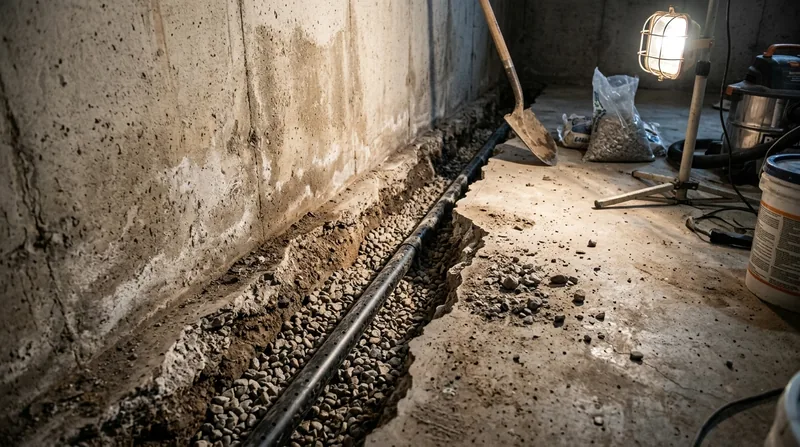


Interior Drain Tile System in Bridgewater: The Fix for Water Under the Slab
Bridgewater sits on Triassic red shale and sandstone, with clay loam in the Raritan River lowlands where the water table stays high after storms. That geology decides how water behaves under your basement floor. An Interior Drain Tile System in Bridgewater captures groundwater at the footing before it rises through the slab and wall joint, then sends it to a sump basin and out. We install these systems in stone cellars in Bridgewater Center, block foundations in Bradley Gardens and Finderne, and poured basements in the 1970s-1990s colonials along the Route 22 corridor. See how this fits our full basement waterproofing program.
Why Interior Drain Tile Matters in Bridgewater's Clay and Shale Ground
In the lowlands near the Raritan River, clay loam holds water like a sponge after a nor'easter or the remnants of a tropical storm. Hydrostatic pressure builds under the slab and finds the weakest point: the cove joint where the wall meets the floor, or a cold pour joint in a 1960s block foundation. Water in the basement after rain is the symptom. The drain tile is the cure.
- Weep lines in the footing clog with shale fines and stop draining, so water backs up under the slab.
- Spring snowmelt and freeze-thaw cycles open old mortar joints in 1800s stone cellars, letting water track down the wall.
- High water table in Finderne and Bradley Gardens keeps the soil saturated for days after a storm.
- Clogged or short downspout extensions dump roof water at the foundation line instead of away from it.
- Original 1950s drain tile under the slab is often crushed, root-filled, or simply not connected to a sump.
When the water is coming from below the slab, sealing the wall face alone will not stop it. The drain tile has to relieve the pressure first.
Key info: A 1962 split-level in Bradley Gardens with water seeping across the floor after every heavy rain is a classic hydrostatic pressure case. The block wall and footing drain are saturated, and an interior perimeter drain is the right fix, not another coat of sealer.
For official guidance on construction and drainage permits, start with the New Jersey Department of Community Affairs, Division of Codes and Standards and confirm local requirements with the Bridgewater Township building department.
How We Install an Interior Drain Tile System in Bridgewater
We break out a 12 to 16 inch strip of slab along the perimeter, dig down to the footing, and set perforated pipe in washed stone with a filter fabric wrap. The pipe runs to a sump basin set at the low corner of the basement. We backfill with stone and concrete over the trench. The basement stays usable throughout, and we work in any season, including a New Jersey winter.
- We walk the basement and identify where water enters: cove joint, tie holes, floor cracks, or window wells.
- We cut and remove the slab edge and excavate down to the footing drain level.
- We install perforated drain tile in washed stone, wrapped in filter fabric to keep clay fines out.
- We set the sump basin, connect the drain line, and install a check valve on the discharge.
- We patch the concrete and test the system with water before we leave.
Every installation includes a discharge line routed to daylight or a dry well, sized to the pump. If you need a new pump or a backup, see our sump pump installation page.
Key info: In a 1978 colonial off Route 22 in Bridgewater, we found the original footing drain full of shale silt. We ran new interior perimeter drain to a 24 inch sump basin and tied in a battery backup. The basement stayed dry through the next spring snowmelt.
Interior Drain Tile Approaches We Use in Bridgewater
The right approach depends on your foundation type, the water table, and how the basement is finished. We match the method to the building, not the other way around.
| Approach | Description | Best for |
|---|---|---|
| Full interior perimeter drain | Perforated pipe in stone along the entire footing, draining to a sump basin. | Finished basements with water across the floor after storms. |
| Partial drain tile run | Drain tile along the wet wall or walls only, tied to an existing sump. | One-wall seepage in a stone cellar or block foundation. |
| Drain tile plus vapor barrier | Interior drain with a wall membrane directing seepage down to the tile. | Damp block walls with efflorescence and a musty smell. |
| Drain tile plus sump and backup | New basin, primary pump, check valve, and battery backup on the discharge. | Lowland homes in Finderne where power outages follow storms. |
If your existing tile is crushed or clogged, our drain tile repair service can often save the run instead of replacing it.
Interior Drain Tile System Cost in Bridgewater: What to Expect
Interior drain tile pricing starts at From $50 per linear foot for a standard perimeter run in an unfinished basement. That figure covers slab cutting, excavation, perforated pipe, washed stone, filter fabric, and concrete patch. A finished basement, a thick 1960s slab, or a long run to the discharge point moves the number up. We give a written scope before any work starts.
- Linear footage of the perimeter drives the base price more than anything else.
- Finished basements add labor for protecting flooring and framing during the cut.
- Stone and rubble foundations in Bridgewater Center take more time to excavate and stabilize.
- Sump basin, pump, check valve, and discharge line are priced as a package.
- Battery backup and a second pump add cost but cover storm-related outages.
Get two or three written estimates and compare scope line by line, not just the total. Our full pricing overview breaks down what each line item includes.
Interior Drain Tile System Near Me: Hiring a Contractor Near Bridgewater
Ask for the license and insurance certificate before anyone walks into your basement. A waterproofing contractor working below grade should carry general liability and workers' compensation. Check references from jobs in Bridgewater, Raritan, or Bound Brook with the same foundation type as yours. Confirm who pulls the permit if the work alters drainage or the sump discharge connection.
- Verify the contractor is licensed and insured, and ask for the certificate by email.
- Get at least three estimates and make sure each one lists pipe, stone, basin, and pump separately.
- Ask for two recent references in Bridgewater or a neighboring town and call them.
- Confirm the permit responsibility in writing before the crew arrives.
- Check HOA rules for discharge line routing and exterior work if you live in a townhouse community.
We are happy to walk you through the scope and answer questions before you commit. Reach us through our contact page to schedule a free basement inspection.
Interior Drain Tile System in Bridgewater: Pricing Guide
| Service | Price | Details |
|---|---|---|
| Interior perimeter drain tile, unfinished basement | Starting at $50/linear ft | Includes slab cut, excavation, perforated pipe, washed stone, filter fabric, and concrete patch. |
| Interior drain tile with sump basin and pump | Starting at $2,800 | Adds basin, primary pump, check valve, and discharge line sized to the run. |
| Drain tile plus vapor barrier and wall membrane | On estimate | Priced after inspection because wall height, damp readings, and finish level vary by basement. |
| Stone or rubble foundation drain tile | On estimate | Older Bridgewater Center cellars need on-site review for excavation and wall stabilization. |
| Travel | Included | In Bridgewater and surrounding towns, no separate call-out or mileage fee. |
| Estimate | Free | Response within 24h at (908) 503-5451, no obligation to book. |
Indicative pricing, the exact cost depends on square footage, finish, and site access. Free personalized estimate within 24h at (908) 503-5451.


